The clock is ticking.
Your family's wealth didn't build itself overnight, and it won't preserve itself by accident. Right now, while you're reading this, the next generation is watching, learning, and forming opinions about how your family handles money, power, and legacy.
Here's the brutal truth: Poor governance kills more family offices than poor investment performance.
The families that thrive for generations? They don't just build wealth: they build systems. They create frameworks that outlast any single family member. They establish governance that transforms chaos into clarity, confusion into confidence.
But most families are making critical mistakes. Mistakes that seem small today but compound into generational disasters tomorrow.
Ready to fix them before it's too late? Let's dive in.
MISTAKE #1: UNCLEAR DECISION-MAKING AUTHORITY
The Problem That's Killing Your Progress
Nothing destroys family harmony faster than ambiguity about who gets to decide what. When authority isn't crystal clear, every decision becomes a battle. Investment approvals stall. Strategic initiatives die in committee. Family members second-guess each other instead of moving forward with confidence.
The biggest source of family office conflicts? Unclear decision-making authority.
The Fix That Changes Everything
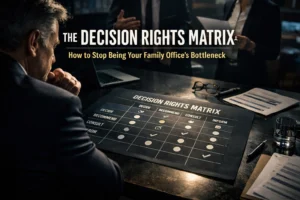
Create decision-making tiers based on dollar amounts and decision types. Here's your framework:
- OPERATIONAL DECISIONS ($0-$100K): Professional staff handles independently
- TACTICAL DECISIONS ($100K-$1M): Family office leadership decides with family notification
- STRATEGIC DECISIONS ($1M+): Full family council approval required
Document this framework. Train every stakeholder. Create escalation paths and conflict resolution mechanisms.
When everyone knows who decides what, decisions happen fast.

MISTAKE #2: ROLES AND RESPONSIBILITIES THAT OVERLAP AND CONFUSE
The Chaos You Can't Afford
Overlapping roles create inefficiencies that compound over time. Accountability gaps emerge. Internal conflict breeds. Family members and staff operate in confusion about what they're supposed to own.
The result? Paralysis when you need action most.
The Solution That Creates Clarity
Develop a governance charter with detailed job descriptions and RACI matrices: who is Responsible, Accountable, Consulted, and Informed for every major function.
Your Implementation Checklist:
- Document every role with specific responsibilities
- Create onboarding workshops to reinforce expectations
- Implement role rotation through job shadowing
- Tie responsibilities directly to performance reviews
Clear roles = Clear results.
MISTAKE #3: NO FORMAL DECISION-MAKING FRAMEWORK
The Informal Trap That Destroys Trust
Over-reliance on informal processes leads to inconsistent decisions, biased outcomes, and zero mechanism to resolve disputes. This undermines the next generation's confidence in governance legitimacy.
Informal might feel easier today. It's devastating tomorrow.
The Framework That Builds Confidence
Create a documented framework detailing who decides what, with clear escalation paths. Supplement with a decision register to track key actions and their rationales.
Your Decision Framework Must Include:
- Decision criteria for each category
- Required approvals and timelines
- Escalation procedures for conflicts
- Regular framework reviews and updates
Train your staff in decision analysis tools. Schedule quarterly reviews to ensure your framework stays relevant.
Structure creates speed, not slowdown.
MISTAKE #4: COMMUNICATION THAT BREEDS MISTRUST
The Silent Killer of Family Wealth
Poor communication kills more family offices than poor investment performance. Irregular updates, unclear alignment between office and family members, lack of transparency: all breed mistrust and disengagement.
The next generation feels uninformed and excluded. Then they disengage completely.
The Communication System That Builds Trust
Establish structured communication rhythms that keep everyone aligned:
YOUR COMMUNICATION CALENDAR:
- Quarterly family meetings for strategic updates
- Annual family assemblies for comprehensive reviews and succession planning
- Regular written performance updates
- Emergency protocols for urgent decisions
Use digital hubs for governance documents. Rotate internal communications leads. Conduct regular feedback surveys to detect misalignment early.
Make transparency and open communication non-negotiable values.

MISTAKE #5: STARTING WITHOUT A CLEAR MANDATE
The Foundation That's Missing
Many families rush into formalizing governance structures without asking fundamental questions: What's our purpose? What outcomes do we want? Who does this office serve now and in the future?
Misalignment that surfaces years later always started with unclear mandates.
The Mandate That Guides Everything
Before any structural decisions, invest in deep education and benchmarking. Form a temporary steering committee to draft an initial vision and clarify non-negotiables.
Begin with a family charter addressing:
- Why does this office exist?
- What are our core values?
- Who does what?
- How do we stay aligned?
Revisit this annually during family retreats to reinforce shared ownership.
Clarity of purpose drives every successful decision.
MISTAKE #6: NEGLECTING FAMILY RELATIONSHIPS AND NEXT-GEN EDUCATION
The Human Element You Can't Ignore
Governance structures become cold, transactional mechanisms when they don't strengthen relationships between family members and between family and staff. The next generation disengages when their voices don't matter.
Technical structures without relational foundations collapse under pressure.
The Relationship Strategy That Works
Make relationships foundational to your governance program:
YOUR RELATIONSHIP-BUILDING SYSTEM:
- Next-generation education plans
- Facilitated family meetings
- Conflict resolution processes
- Regular team-building activities
Start with an advisory group model: convene a trusted external advisor, a rising-generation member, and an operator to meet quarterly. This creates accountability and a proving ground for future leaders without forcing early formal appointments.
Strong relationships make tough decisions possible.

MISTAKE #7: STATIC GOVERNANCE THAT DOESN'T EVOLVE
The Death by Rigidity
Governance structures created for one generation often become outdated as family dynamics shift, markets change, and external risks evolve. The next generation inherits rigid systems that don't reflect their needs or capabilities.
What worked yesterday might destroy tomorrow.
The Evolution Strategy That Lasts
Build adaptability into your framework from the start:
YOUR EVOLUTION CHECKLIST:
- Review governance structures annually
- Maintain a living knowledge repository
- Start with informal structures before formalizing everything
- Plan for regular reviews and adjustments based on experience
Treat governance as iterative, not a one-time project.
The families that last are the families that adapt.
THE PATH TO GENERATIONAL SUCCESS
The most successful transitions to next-generation leadership happen when governance is established early with clear authority, transparent roles, regular communication, and adaptive frameworks.
Don't delay structural formalization. Governance built intentionally early prevents costly conflicts later.
Your family's wealth represents more than money: it represents opportunity, impact, and legacy. The systems you build today determine whether that legacy thrives or dies with the next generation.
The time to act is now.
Ready to build governance systems that protect and grow your family's wealth for generations?
The families who get this right don't figure it out alone. They work with advisors who understand both the technical requirements and the human dynamics of family wealth.
Schedule a confidential strategy session today and discover how to build governance frameworks that turn potential family conflicts into collaborative success.
Your legacy depends on the decisions you make right now.