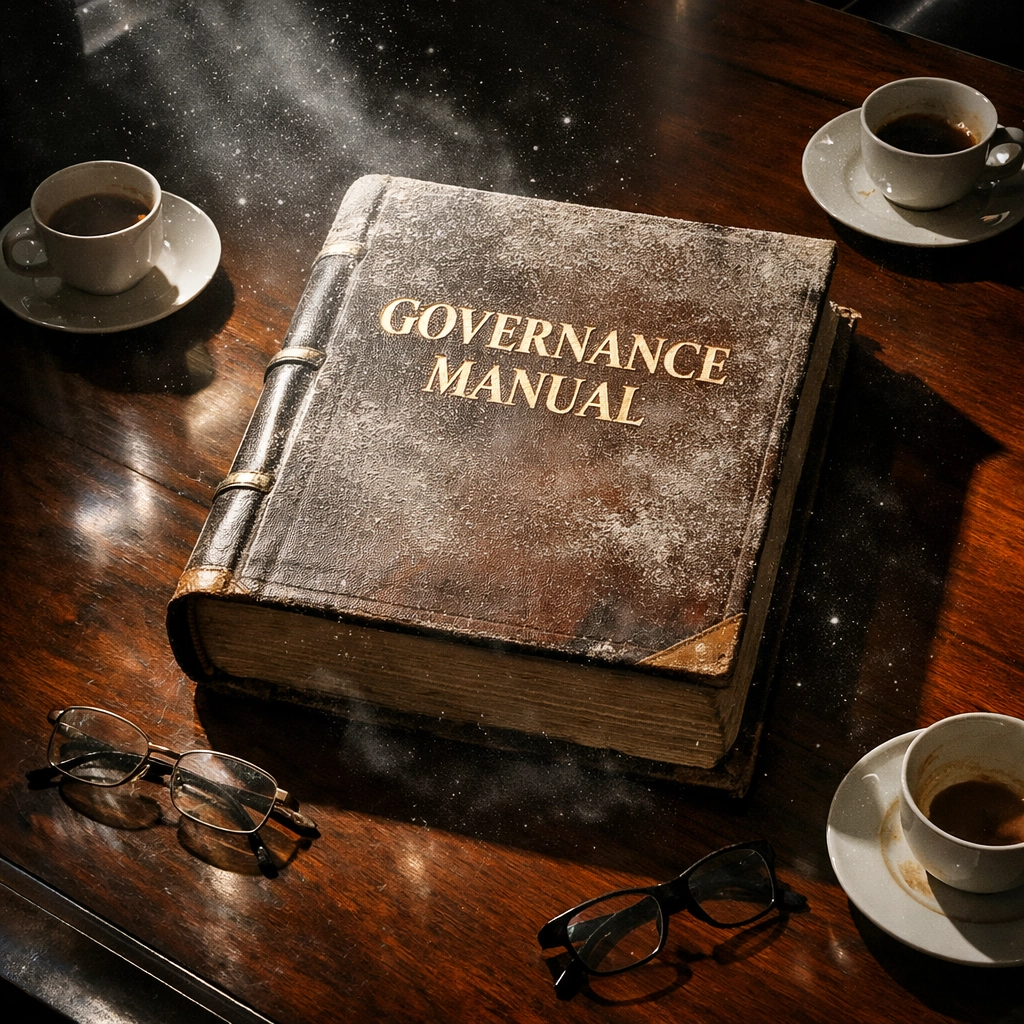
Here's the truth nobody tells you: The thicker your governance charter, the less likely anyone will actually follow it.
I've seen 147-page family office governance documents gathering dust while the real decisions happen over dinner. I've watched operating committees spend months designing elaborate approval matrices that break down the first time someone needs a fast decision.
The problem isn't that governance doesn't matter. The problem is we confuse complexity with competence.
THE COMPLEXITY TRAP: Why Smart People Build Systems That Don't Work
You bring in the consultants. They deliver a beautiful binder. It covers every scenario, every edge case, every possible contingency. It has flowcharts, decision trees, escalation protocols, and a glossary.
And it never gets used.
Why? Because complexity creates three fatal problems:
Nobody reads it. When your governance document requires a law degree and three hours to understand, people improvise instead. The document becomes decorative.
Nobody remembers it. Even if they read it once, they won't recall the details when they need them. Decision-making happens in real-time, not after consulting a manual.
Nobody trusts it. Complex systems feel like bureaucracy, not protection. Teams interpret them as obstacles rather than tools. So they route around them.
The painful irony: You built complexity to reduce risk. But complexity itself becomes the risk.
THE SIMPLICITY SECRET: What Actually Works When Stakes Are High
Simple governance isn't simplistic. It's surgical.
The best family offices and scaling companies I work with don't have elaborate governance architectures. They have crystal-clear decision rights and operating rhythms.
Here's what that looks like in practice:
ONE-PAGE DECISION RIGHTS MAP
Who decides what. That's it. Not a framework for how to decide. Not a philosophy. Just a clean map:
- Investment decisions over $500K: Investment Committee (3 votes required)
- Operating expenses over $100K: Managing Partner approval
- Hiring key roles: Hiring Manager proposes, Leadership Team approves
- Philanthropic commitments: Family Council decides
Notice what's missing? Paragraphs of context. Elaborate justifications. Nested clauses.
SIMPLE DASHBOARDS, CRISP PROCESSES
Your governance dashboard should fit on one screen. I mean it. If stakeholders can't glance at it and know the status instantly, you've already lost.
Track what matters:
- Cash position and runway
- Top 5 risks this month (not 37 risks ranked by color-coded severity)
- Decisions pending (who owns it, deadline)
- Key metrics vs targets
That's your governance heartbeat. Everything else is commentary.
OPERATING CADENCE THAT DOESN'T BREAK
Forget quarterly strategic reviews that turn into multi-day retreats. Build a rhythm that's so simple it's inevitable:
- Weekly 15-minute leadership check-in (same time, same agenda: wins, blockers, decisions needed)
- Monthly 60-minute dashboard review (numbers, risks, one strategic topic)
- Quarterly half-day priorities reset (3-5 rocks for the next 90 days)
The magic isn't in the sophistication. The magic is in the consistency.

WHY SIMPLE ACTUALLY SCALES (And Complex Collapses)
I've watched this pattern hundreds of times. The $5M family office tries to implement Goldman Sachs-level governance. The $15M company adopts Fortune 500 committee structures.
And they stall out.
Here's why simple beats complex at every stage:
CLARITY COMPOUNDS
When everyone knows who decides what, decisions happen fast. No ambiguity. No "I thought you were handling that." No committee paralysis disguised as collaboration.
Speed isn't recklessness. Speed is what happens when confusion disappears.
TRUST SCALES
Complex governance says "We don't trust you to make good decisions without extensive documentation and oversight."
Simple governance says "Here are the boundaries. Here's who owns what. Go execute."
One creates bureaucrats. The other creates owners.
ADAPTATION SURVIVES
Markets move. Opportunities appear. Crises hit. The complex governance system forces you to schedule a meeting, review the protocols, check the decision matrix, and escalate to the appropriate subcommittee.
By then, the opportunity is gone.
Simple governance lets you move at the speed of reality. You know who decides. They decide. You act.

WHAT SIMPLE GOVERNANCE LOOKS LIKE IN THE REAL WORLD
Let me show you what I mean with two real examples (details changed to protect confidities):
Family Office Example:
Client came to me with a 89-page governance charter. Decisions were taking 4-6 weeks. Family members were frustrated. Staff was demoralized.
We replaced it with:
- One-page decision authority matrix (8 decision types, clear dollar thresholds, named decision-makers)
- Monthly one-page dashboard (net worth, liquidity, top 3 risks, pending decisions)
- 30-minute monthly family governance call (same agenda every time)
Result? Decision time dropped to 3-5 days. Satisfaction scores doubled. Staff retention improved because people could actually execute.
Operating Company Example:
Scaling company at $18M revenue had built elaborate approval workflows. Everything required multiple sign-offs. Deals were dying in committee. Team morale was tanking.
We simplified to:
- Clear spending authority by role (VPs could approve up to $50K, department heads up to $10K)
- Weekly 15-minute leadership standup (blockers and decisions only)
- Quarterly priorities (3 company rocks, each team picks their supporting rocks)
Result? Closed three deals in 45 days that had been stalled for months. Team velocity increased visibly. The CEO stopped being a bottleneck.
In both cases, we removed 80% of the governance structure and got better results.
THE FOUR ELEMENTS YOU ACTUALLY NEED
If you're building or fixing governance right now, here's your checklist. Four elements. That's it.
1. DECISION RIGHTS (One Page)
List the decisions that matter in your organization. Assign a clear owner to each. Set thresholds if relevant. Done.
2. OPERATING RHYTHM (Non-Negotiable Cadence)
Weekly check-in. Monthly review. Quarterly reset. Same time. Same format. No exceptions.
3. DASHBOARD (One Screen)
Five to ten metrics max. Green/yellow/red status. Updated weekly. Everyone sees the same numbers.
4. CONFLICT RESOLUTION (Clear Escalation Path)
When people disagree, what happens? Write it down. One paragraph. Make it boring and clear.
That's it. Four elements. You could implement all four this month.
THE WAKE-UP QUESTION
Here's how you know if your governance is too complex:
"If your key decision-maker disappeared for 30 days, would your organization still function?"
If the answer is no, your governance isn't governance, it's dependence on a person. And that person is probably exhausted.
If the answer is yes, your governance is probably simple enough to actually work.

SIMPLE ISN'T EASY (But It's Worth It)
Let me be clear: Building simple governance is harder than building complex governance.
Complex governance is easy. You cover everything. You add clauses for edge cases. You build in redundancy. You feel thorough.
Simple governance is difficult. You have to make choices. You have to decide what matters and what doesn't. You have to live with some ambiguity. You have to trust people.
But simple governance is the only kind that actually survives contact with reality.
Your governance system should pass the dinner napkin test: Can you explain it clearly in five minutes on the back of a napkin?
If not, you're governing for theory, not practice.
YOUR NEXT MOVE
If you're reading this and thinking "our governance is a mess," you're not alone. Most organizations overcomplicate it because they think complexity signals sophistication.
It doesn't. Clarity signals sophistication.
Here's what I'd do this week if I were you:
Take your current governance documents. All of them. Stack them up. Now ask: "If I had to reduce this to ONE page that actually gets used, what would be on it?"
Write that page. Test it for 30 days. Adjust what doesn't work.
Governance isn't about documentation. It's about making good decisions consistently.
And the simplest system that gets used beats the most elegant system that sits in a drawer.
Want to pressure-test your governance setup or build something simple that actually works? I'll help you cut through the complexity. Book 15 minutes here and let's make your governance something people actually follow.
Because the best governance system is the one that disappears into execution.
Simple dashboards. Crisp processes. Clear decisions.
That's the secret. Always has been.