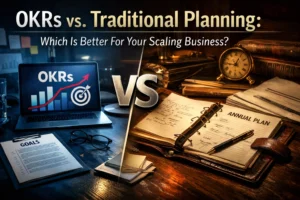
Here's what nobody tells you about scaling: The planning method that got you here will absolutely break you at the next level.
I've watched it happen dozens of times. A founder builds something beautiful, $3M, $5M, maybe $10M in revenue. The team's humming. Customers love the product. Then they try to scale, and suddenly everything feels like pushing a boulder uphill in molasses.
The problem? They're using an annual planning system built for stability in an environment that demands speed, adaptation, and alignment at scale.
The Old Way Is Dying (And You Know It)
Traditional planning made sense in a different era. Set your goals in January. Lock them down. Execute for 12 months. Review in December. Rinse and repeat.
But scaling businesses don't operate on annual calendars anymore. Markets shift in weeks, not years. Competitors launch products overnight. Customer needs evolve faster than your quarterly board meeting.
If you're still planning like it's 2005, you're planning to lose.

What Traditional Planning Actually Looks Like When You Scale
Let's get real about what happens when you try to scale with traditional planning:
Your goals live in a document nobody reads. The strategic plan gets presented once, filed away, and forgotten. Three months later, your team can't remember the top three priorities because they've been buried under 47 "urgent" projects.
Everything is a fixed commitment. You committed to Project X in January. It's now June. The market has shifted. Customers want something different. But you're still executing Project X because "it's in the plan."
Departments work in silos. Sales doesn't know what Product is building. Marketing doesn't know what Sales promised. Operations is wondering why nobody told them about the expansion. Everyone is busy. Nothing is aligned.
Changes take forever. Want to pivot? You'll need to wait for the next planning cycle. Want to reallocate resources? That requires executive approval and probably a board meeting. By the time you make a decision, the opportunity is gone.
Strategy lives at the top. Executives have the vision. Everyone else has tasks. Nobody connects the dots between daily work and company direction.
Sound familiar? That's the cost of traditional planning at scale.
Enter OKRs: The Operating System For Growth
OKRs, Objectives and Key Results, aren't just another planning framework. They're the operating system that scaling companies run on.
Here's why they work when traditional planning fails:
Speed Built Into The System
OKRs operate on quarterly cycles, not annual ones. Set your objectives for 90 days. Review your key results weekly or bi-weekly. Adjust as reality hits the plan.
This isn't about abandoning strategy. It's about executing strategy in a way that respects the speed of modern business. You maintain long-term vision while building in the agility to adapt.
Think about it: In three months, you can test a hypothesis, learn from the market, and adjust. In twelve months, you can be stuck executing a plan that stopped making sense six months ago.
Transparency That Scales Alignment
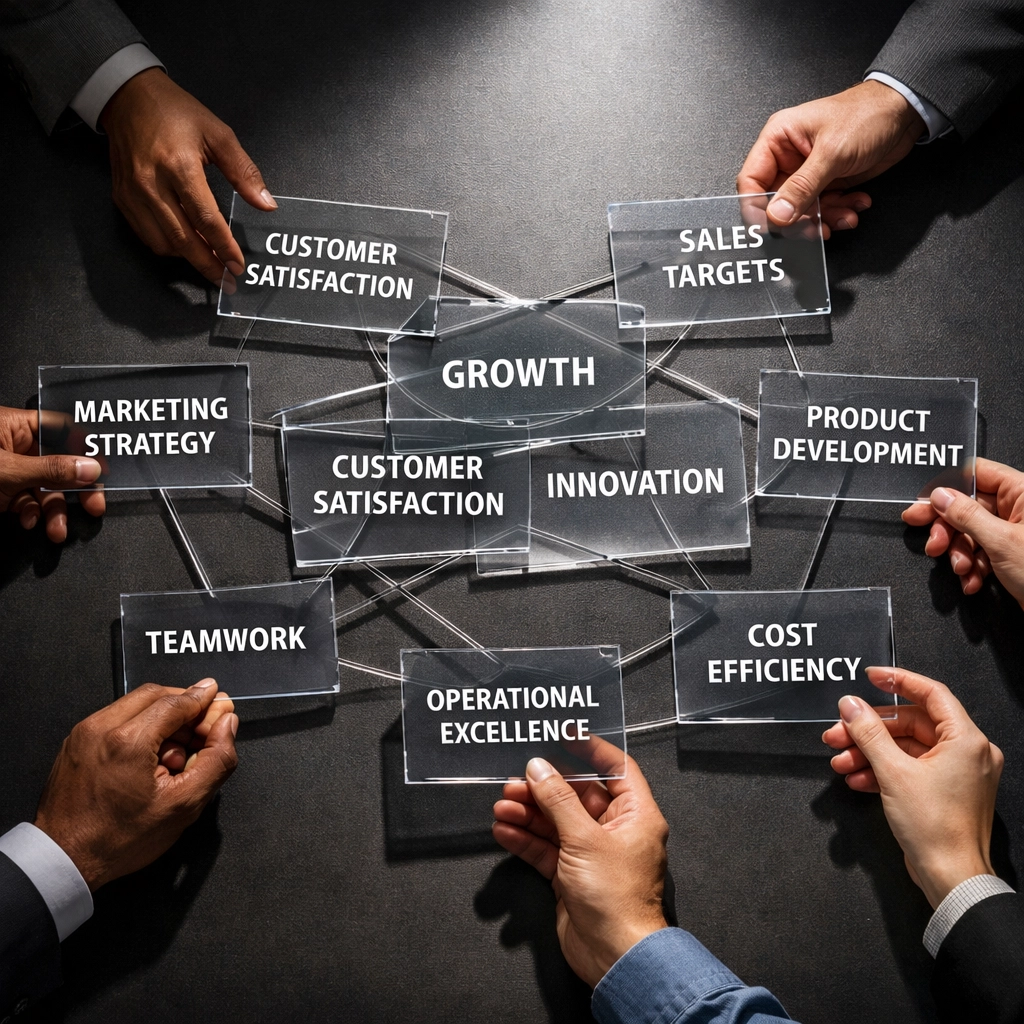
Here's where OKRs become transformational: Everyone can see everyone else's objectives.
Your sales team can see what product is building. Product can see what sales is promising. Operations can see what's coming down the pipeline. Executives have their own OKRs that everyone can view.
This isn't about surveillance. It's about coordination at scale without endless meetings. When transparency is the default, alignment becomes natural. Teams self-organize around shared objectives. Silos dissolve because people can see how their work connects to the bigger picture.
Outcomes Over Outputs
Traditional planning asks: "What projects will we complete?"
OKRs ask: "What outcomes will we achieve?"
This shift is everything.
Instead of tracking that you launched Feature X, you measure whether Feature X actually moved customer retention. Instead of celebrating that you hired 10 salespeople, you measure whether revenue increased.
Outputs are activity. Outcomes are impact. Scaling businesses need impact.
Strategic Clarity From Top To Bottom
In an OKR system, executives don't just set strategy, they set OKRs. Their objectives are visible. Their key results are measurable. Everyone can see what leadership is focused on and why it matters.
This creates a line of sight from the CEO's desk to the newest team member. Strategy isn't a document, it's a living, breathing set of priorities that cascade through the organization.
When your VP of Sales can see the CEO's OKR around market expansion, they can align their team's OKRs to support it. When product teams can see revenue objectives, they can prioritize features that move the needle. Strategy becomes executable because it's transparent and connected.
The Real Question: Can You Afford NOT To Switch?
I get the hesitation. Change is hard. Your team is already busy. Learning a new system feels like one more thing on the pile.
But here's what I tell every founder I work with: The cost of switching to OKRs is temporary. The cost of staying with traditional planning is permanent.
Every quarter you spend executing disconnected initiatives is a quarter your competitors are spending executing aligned strategy. Every month your team wastes on projects that don't move the business forward is time and money you'll never get back.

What Switching Actually Looks Like
Let's make this practical. You don't need to blow up your entire organization overnight.
Start small. Pick one team or department. Set 3-5 objectives for the next 90 days. Define 2-3 key results for each objective. Review weekly. Adjust as you learn.
Make it visible. Put OKRs where people can see them: shared docs, team dashboards, all-hands meetings. Transparency is the point.
Connect to strategy. Ensure team OKRs ladder up to company objectives. If it doesn't connect, it doesn't belong.
Review and iterate. Weekly check-ins on key results. Monthly reviews on progress. Quarterly resets for new objectives. This is how you build momentum.
Celebrate outcomes, not just effort. Did you hit the key result? Celebrate. Did you learn something valuable? Celebrate. Did you discover a better path? Adjust the OKR and keep moving.
The magic happens when your team starts to think in outcomes instead of tasks. When they can connect their daily work to company strategy. When they start proactively adjusting based on what they're learning in the market.
That's when you're not just scaling: you're scaling with intention, alignment, and speed.
The Choice That Defines Your Next Chapter
Here's the truth: Most scaling businesses fail not because they lack talent, capital, or market opportunity. They fail because they can't coordinate growth.
They hire faster than they can align. They launch initiatives faster than they can integrate them. They move fast, but they move in different directions.
Traditional planning can't solve this. It was designed for stability, not scale. It optimizes for compliance, not impact. It creates the illusion of control while breeding chaos under the surface.
OKRs solve the coordination problem. They create alignment without bureaucracy. They enable speed without chaos. They turn strategic intent into daily execution.
The question isn't whether OKRs are better than traditional planning for scaling businesses. The question is whether you're ready to operate at the speed and alignment your growth demands.
If you're serious about scaling: really scaling, not just adding revenue but building something that compounds and endures: then you need an operating system built for that reality.
OKRs are that system.
The companies that scale successfully over the next decade won't be the ones with the best strategy documents. They'll be the ones with the best execution systems. The ones that can set direction, align teams, move fast, and adjust without losing momentum.
That's what OKRs unlock. That's what separates the companies that scale from the ones that stall.
What's Your Next Move?
If you're still running on traditional planning and wondering why scaling feels harder than it should, you now know why. The system you're using wasn't built for where you're going.
The good news? You can change systems faster than you think. One quarter is all you need to test OKRs with one team. Three quarters is enough to see transformation across your organization.
The real question is: Will you make the shift before your competitors do?
If you want help thinking through how OKRs could work in your specific business: or if you want to pressure-test whether your current planning system is really serving your growth: let's talk. Book 15 minutes here: https://tallpinze.com/contact
Your next level of scale is waiting. But it requires a new way of operating.
The companies that win the next decade will be the ones that operate with clarity, alignment, and speed.
OKRs give you all three.
What are you waiting for?